
How Does God’s Word Inform Your Policies?

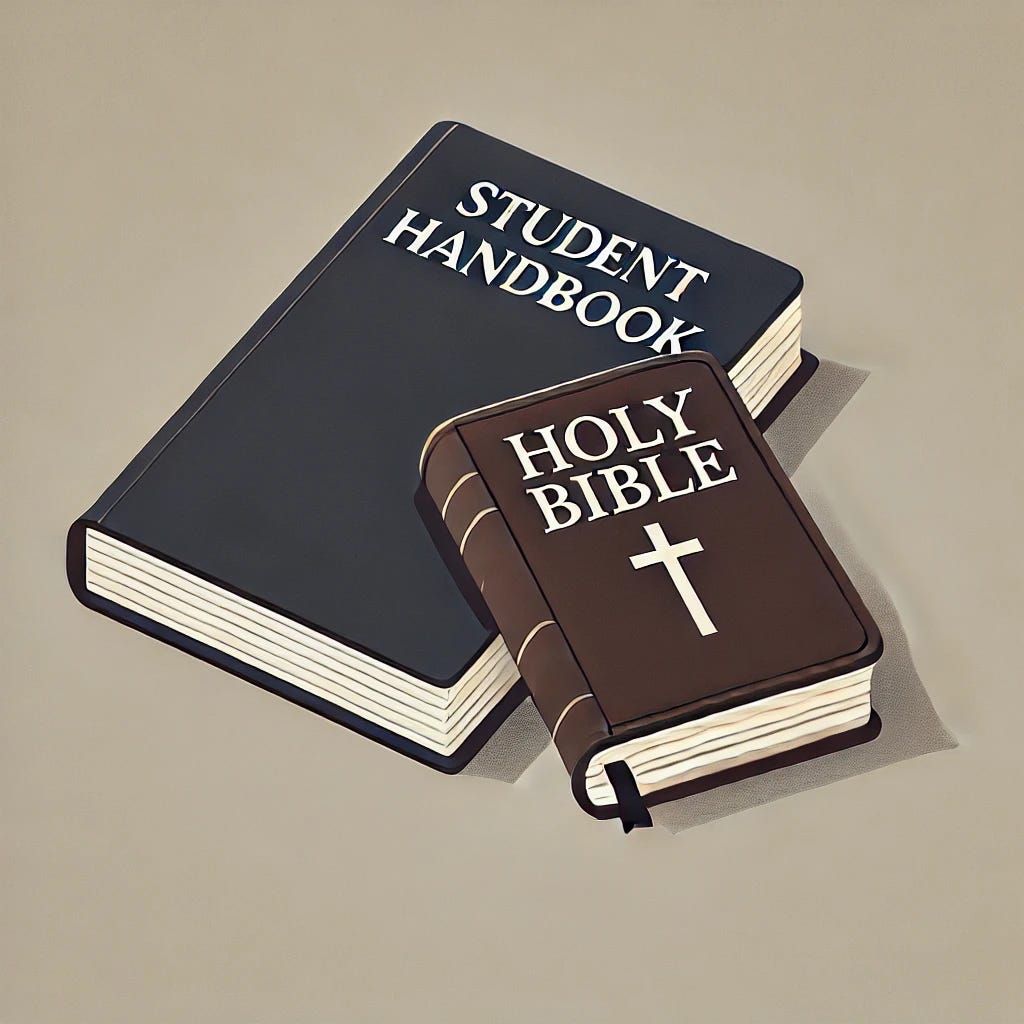
For many Christian schools, policies are often shaped by external factors state laws, secular best practices, accreditation standards, the latest trends in education, or maybe even just a template borrowed from another school. Yet, leaning solely on these sources risks overlooking a critical aspect of what makes a school distinctively Christian…God’s Word. In fact, I contend that a Christian school cannot fully honor its calling without doing the hard and ongoing work of aligning its policies with Scripture…as a lamp unto our feet and a light unto our paths…even our policy paths.
Recognizing the Two Kingdoms
God’s Word teaches that God rules over all creation through two distinct kingdoms: the kingdom of the left and the kingdom of the right. Both are under His authority and serve His purposes, but they operate in different ways.
In the kingdom of the left, God works through earthly means. This might be laws and institutions to maintain order in the world, but it also includes structures like policies and rules in schools.
In the kingdom of the right, God works through the Gospel to bring forgiveness, salvation, and ultimately eternal life in Christ. This kingdom is focused on the redemptive work of Christ and the proclamation of the Gospel.
In a Christian school, these two kingdoms intersect. Policies must uphold the order and structure of the kingdom of the left while the school should also be a place where the entirely of God’s Word is taught and God’s love in Christ is proclaimed.
Policies like student handbooks, dress codes, technology use policies, and discipline procedures exist to provide order. However, I contend that they can also point to the redemptive purpose of the Gospel.
Law and Gospel in Policies
Central to unerstanding and applying the Bible is this distinction between Law and Gospel. The Law, revealed in God’s Word, teaches what is right and wrong, holding us accountable for sin and showing our need for a Savior. The Gospel, on the other hand, proclaims the good news that, “we are saved by grace through faith in Christ, not by works os that no one may boast.”
Policies naturally lean on the Law, and that is okay. After all, as the Psalmist reminds us, “the law of the Lord is good/perfect, reiviving the soul (Psalm 19:17). It points us to the very character an nature of God, even as it reminds us how we fall short of that standard. Alas, there are rules, processes, expectations, and consequences in policies. While these are necessary, a Christian school has the distinct opportunity to think about policies in a very different way.
Consider some examples…
Discipline Policies - Beyond correction, policies can include a process for restoration and reconciliation, reflecting Christ’s forgiveness. This does not mean that we dismiss or downplay sin and wrongdoing, or that we cannot and do not sometimes need to remove people from the community in unfortunate situations. However, it does mean that we also consider biblical wisdom related to repentance and forgiveness, reconciliation, and a reminder that our worth does not ultimately depend upon our accomplishments, but upon God’s character, His promises, and His love in Christ.
Admissions Policies - Instead of solely focusing on academic qualifications, policies can reflect a desire to serve families seeking a Christ-centered education that point all to the love of God in Christ. They can be a reminder of the schools reason for existence. This does not mean lowering academic standards, but it does mean putting them in biblical and even an eternal perspective.
Technology Use Policies - These not only address misuse, but also encourage students to use technology in ways that glorify God and point others to God’s love in Christ. Even more, technology use policies can include reminders of God’s promises, His good gifts of deep and meaningful relationships (and that “it is not good for man to be alone”), our identity in Christ, and so much more.
Student Handbooks - Instead of just listing rules, we can include portions of Scripture that reflect the school’s mission and purpose. We can use the handbook to teach students and families how the school’s policies align with its Christ-centered mission. This is an often-overlooked but powerful way to illustrate the significance of God’s Word and its relevance to all aspects of life, even the seemingly mundane.
Dress Codes - Of course, we want these to teach and encourage modesty and respect for oneself and others. Alongside them, once more we have a chance to center this on what God’s Word teaches about Him, us, His love and promises, and His will for us. What a beautiful opportunity to also remind students that we are “covered in a robe of righteousness”, and the “arbor of God”!
A Missed Opportunity
When we rely solely or predominantly on secular laws or educational trends for our policies, we miss a powerful opportunity to illustrate part of what is distinct about Christian education. By grounding policies in God’s Word, we turn everything from from discipline to dress codes into something that points students to their Creator and Redeemer. This approach not only sets a Christian school apart. It also ultimately proclaims the hope and redemption found in Christ, offering greater clarity about what it means to walk the light of God’s Word.
Disclaimer: Did you use AI to write this article. Since AI is so widespread today, I like to be direct about the question. The answer is no. I wrote this article myself, typos and all. I did use an AI-generated image.